Algarve
The DecameronThe Algarve is the promised destination and eventual kingdom of Alatiel’s marriage in the Second Day’s seventh story. It is not the setting of the adventures that occupy most of her account: instead, the intended wedding there frames a long Mediterranean journey of shipwreck, captivity, and successive changes of household. Her eventual arrival brings the tale back to its starting arrangement, but under a public story that conceals the experiences separating departure from return.
Geographic Identity and Political Setting
The story presents the Algarve as a kingdom whose ruler seeks a marriage alliance with Berminedab, the Soldan of Babylon. A book annotation identifies the name with the southernmost province of Portugal, while noting that it apparently refers to a region that remained under Muslim rule until the second half of the thirteenth century. The tale’s geography therefore makes the Algarve more than a distant destination: it places the proposed marriage within a political landscape of Muslim rulers and contested territories.
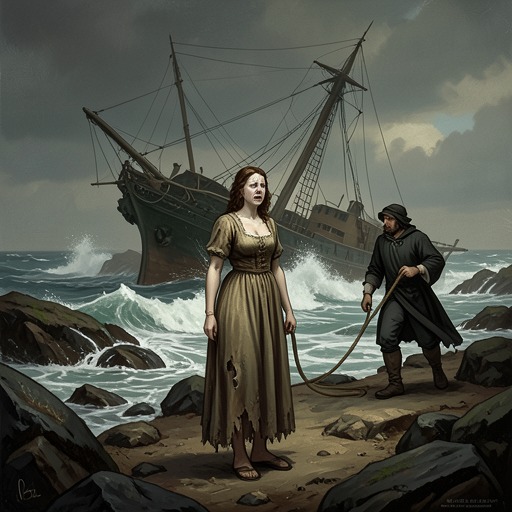
The journey begins at Alexandria, where Berminedab sends Alatiel aboard a well-equipped ship with a substantial retinue and rich furnishings. Its intended course toward the Algarve establishes the route that fortune will interrupt. After passing Sardinia, the ship is caught in a violent storm near Majorca. The sailors abandon the leaking vessel in an overloaded boat and drown; the ship, carrying Alatiel and her women, is driven ashore. The planned passage to the Algarve thus becomes the first leg of a much longer sequence of forced movement.
The Marriage Destination and Its Political Purpose
Alatiel’s marriage to the King of Algarve is arranged as a reward for his military assistance to Berminedab. After the King of Algarve helps defeat a large force of Arabs, Berminedab grants Alatiel to him in marriage as a particular favor. She is dispatched with an honorable company and costly goods, and the Soldan commends her to God. The match gives the story’s opening voyage a diplomatic purpose: Alatiel is being sent not simply to a husband but from her father’s court to a foreign ruler who has earned the alliance.
The tale’s opening summary marks the distance between plan and outcome in time as well as geography: over four years, Alatiel comes into the hands of nine men in various places before being restored to her father and sent onward to the Algarve. The kingdom remains the intended endpoint even while the ship’s route and her circumstances change. The plot’s many displacements are measured against the original marriage arrangement, which persists as a destination she cannot reach by the path first laid out.
A Destination Deferred Across the Mediterranean
The narrative moves Alatiel far from the Algarve. After the wreck, other rulers and households take her in turn; among the recorded episodes, Osbech finds her in Smyrna after capturing her with Constantine and makes her his wife. Later, Antigonus of Famagosta encounters her in Baffa, where she has been living in poor circumstances and is believed drowned. She tells him what has happened since the shipwreck, and he promises to restore her first to her father and then to the King of Algarve.
That return depends on more than finding a route home. Antigonus asks the King of Cyprus to send Alatiel to Berminedab under his protection, presenting the act as a service that will bring honor to the king and benefit to himself. The King agrees, receives Alatiel with honor at Famagosta, and then sends her to her father with a distinguished company. Only after Berminedab welcomes her back does the original plan resume: he informs the King of Algarve of the circumstances and invites him to send for her. The Algarve becomes reachable again through recognition, diplomatic hospitality, and a carefully managed account of her past.
Arrival and the Restored Marriage
Alatiel’s final passage to the Algarve reverses the opening voyage. At first, she leaves her father’s protection for a marriage abroad and is lost to him in the storm’s aftermath; at the end, she is escorted back to him and then received by the ruler for whom she was originally intended. The King of Algarve welcomes her joyfully, and Alatiel lives with him as queen. The return restores the outward political arrangement that had existed before the shipwreck, though it cannot undo the events the tale has recounted.
The restoration also rests on a constructed reputation. Antigonus praises Alatiel’s conduct and represents her as chaste and virtuous; Berminedab is pleased by this account, and Alatiel answers questions about her adventures according to Antigonus’s instructions. When she reaches the King of Algarve, the story says that she is put to bed with him as a maid and allows him to believe that she is one. The marriage is therefore made possible not by an open reckoning with her history but by a narrative that permits the original alliance to proceed.
Narrative Significance
As a place, the Algarve functions chiefly as a deferred endpoint: the reader knows from the beginning where Alatiel is supposed to go, while the story repeatedly carries her elsewhere. Its distance lends shape to the succession of reversals. Each change of location delays the marriage, and her eventual arrival gives the tale a return to its point of departure without making the intervening history disappear.
The ending binds geographic return to the management of sexual reputation. Alatiel’s father and the King of Algarve receive her as the bride their arrangement had promised, but this continuity depends on what is said—and left unsaid—about her experiences. The tale’s final irony is concentrated in the contrast between her actual passage through many hands and the public identity under which she enters the Algarve as queen. The kingdom closes the route; it does not disclose the full journey.